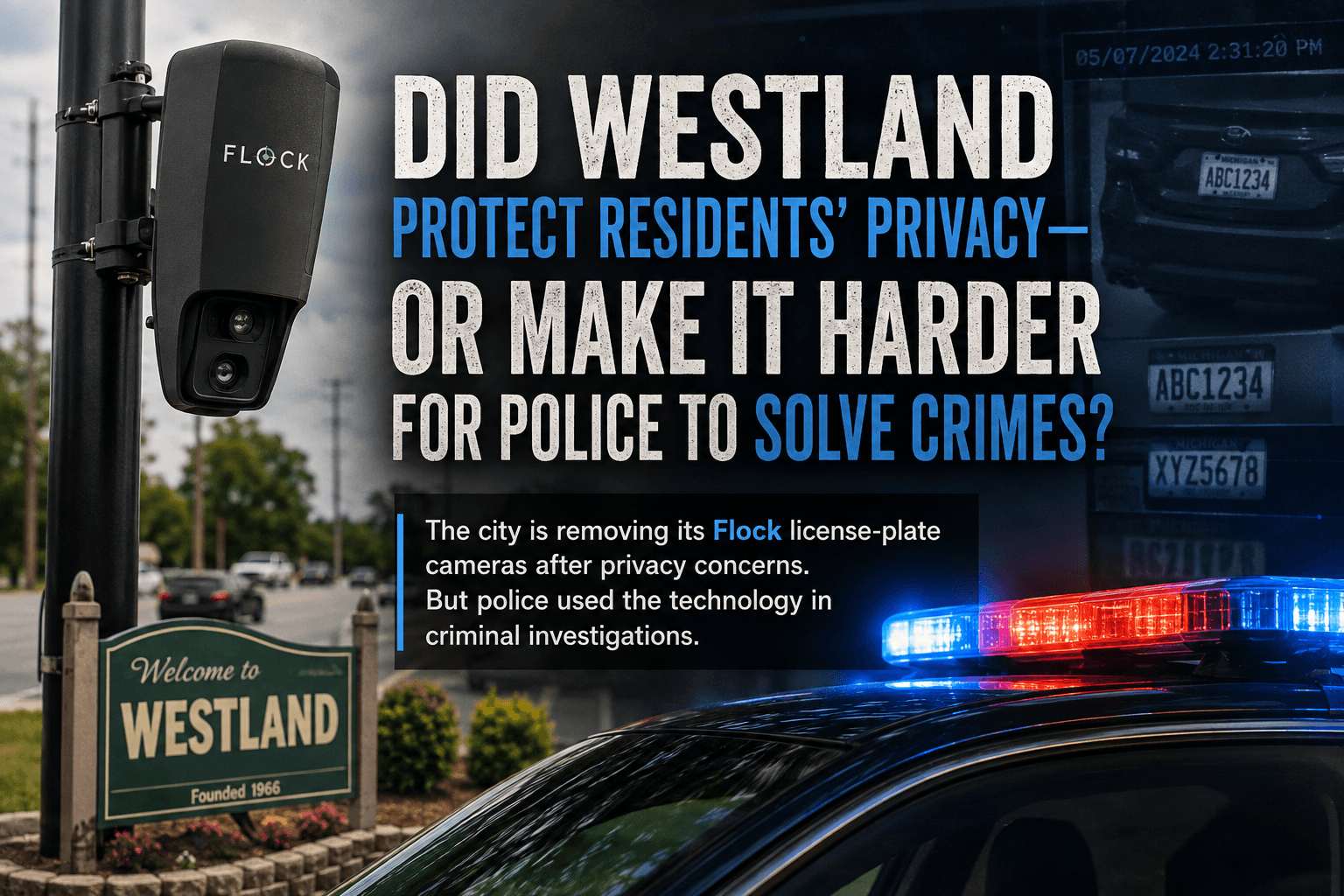
Did Westland Protect Residents' Privacy or Make It Harder for Police to Solve Crimes?
Westland is removing 10 license-plate cameras after residents raised surveillance concerns. But police used the technology in criminal investigations. So what exactly did the city give up?
WESTLAND, MI The cameras are coming down.
Ten automated license-plate readers installed around Westland will no longer be operating under the city's Flock Safety contract after July 2026.
The decision followed months of debate over privacy, government surveillance, data access and police use of the technology.
But there is another side to the story that deserves equal attention:
Westland police actually used the cameras to investigate crimes.
So the question for residents isn't simply whether Flock cameras were intrusive.
It's this:
Did Westland protect its residents' privacy or make it harder for police to solve crimes?
The answer may not be as simple as either side would like it to be.
Westland spent $67,100 on the cameras
In July 2024, Westland City Council approved a two-year agreement with Flock Safety for the delivery, installation and servicing of 10 automated license-plate readers.
The approved amount was $67,100.
The council also approved a separate agreement with Axon Enterprises to activate the automated license-plate-reader function on existing police camera equipment, at a cost of $78,081.87.
The Flock cameras were primarily positioned around major roads, including the Ford Road area.
The technology does something relatively simple but potentially powerful.
It photographs passing vehicles and reads their license plates.
That information can then be searched by police during investigations.
The technology does not require an officer to physically see a suspect's vehicle.
Instead, investigators can potentially work backward:
Where was the vehicle?
When was it there?
Where did it go next?
And that can be valuable when detectives are trying to reconstruct a crime.
We know of at least one Westland case where Flock mattered
This is where the debate becomes more complicated.
In April 2025, a jewelry store on Warren Road was robbed.
Westland police were able to use Flock data to identify a vehicle connected to the investigation.
Surveillance footage showed a black sedan in the area of the jewelry store. Investigators then used Flock cameras to identify the same vehicle traveling near Warren and Newburgh roads earlier that day and later near Ford and Wayne roads.
The vehicle's license plate was associated with John Talerico, a Westland resident, according to court documents cited by ClickOnDetroit.
Investigators subsequently connected Talerico to the robbery and recovered a necklace that police said had been stolen from the jewelry store and pawned later that day.
That doesn't mean Flock alone solved the case.
It doesn't.
Detectives also had surveillance footage, pawn-shop records, vehicle information and other evidence.
But the Flock information was one piece of the investigative chain.
And that's important.
Because when Westland decided not to renew the Flock contract, it wasn't eliminating a technology that police had never used.
It was eliminating a tool that had been used in an actual Westland criminal investigation.
There was more than one example
Flock Safety has also identified a Westland kidnapping investigation as an example of its technology being used to locate a suspect.
According to Flock, investigators used vehicle intelligence from its license-plate-reader network to help locate and identify a person accused of kidnapping a woman from a gas station.
That information comes from the company itself, rather than an independent audit, so Voice of Westland would not treat Flock's claim as proof that the camera system was solely responsible for solving the case.
But it raises a question we think the city should answer:
How many Westland criminal investigations actually benefited from Flock during the two years the city had it?
We shouldn't have to rely on the technology company to tell us.
We should be able to ask the Westland Police Department.
So why did the cameras come down?
Because residents objected.
Residents repeatedly attended City Council meetings and questioned the technology's implications for privacy, government surveillance, transparency and oversight.
Councilwoman Melissa Sampey said it became apparent that community opposition to the system was significant.
And City Council President Mike McDermott, who initially supported a two-year trial, later said he believed supporting the cameras had been a mistake.
His concerns included privacy and constitutional issues, as well as the possibility of data being accessed by outside agencies.
That's a serious concern.
A license-plate reader doesn't need to know your name to record something about you.
It only needs to see your vehicle.
If you drive past a camera, the system can potentially record your plate, the time and location and other characteristics of the vehicle.
Now consider what happens when multiple jurisdictions operate similar systems.
Your trip doesn't necessarily stop being visible when you cross a city boundary.
That's the privacy argument
Supporters of removing Flock cameras argue that residents shouldn't have their movements captured simply because they're driving down a public road.
That's a legitimate concern.
Most people driving through Westland aren't suspected of committing a crime.
They're going to work.
They're taking their kids somewhere.
They're going shopping.
They're visiting family.
They're going to a doctor's appointment.
They're driving home.
And they didn't necessarily consent to having their vehicle's movements become part of a searchable database.
That's the uncomfortable part of automated surveillance.
The system doesn't know whether you're innocent or guilty when it records you.
It records first.
The question becomes who can search the information, why they can search it, how long it is retained and whether anyone is watching the people doing the searching.
Those are reasonable questions.
But there's a public-safety argument, too
Police don't see Flock the same way privacy advocates do.
To an investigator, a license plate can be a lead.
A stolen car.
A missing person.
A robbery suspect.
A vehicle connected to a homicide.
A kidnapping investigation.
In those situations, knowing where a vehicle was at a particular time could mean the difference between having a lead and having nothing.
Flock itself argues that removing the technology can slow investigations.
The company said its technology supported more than one million criminal investigations and incidents in 2025, and claimed it contributed to an estimated 20% of solved cases in jurisdictions where it was deployed. Flock also said its technology helped locate more than 10,000 missing people.
Those are Flock's numbers, not an independent assessment of Westland's experience.
And that distinction matters.
What we don't know is perhaps the most important part
Westland's decision would be much easier to evaluate if residents could see the numbers.
How many times did Westland police search Flock data?
How many investigations involved a Flock-generated lead?
How many stolen vehicles were recovered with its assistance?
How many arrests resulted?
How many cases were cleared?
How often did another law-enforcement agency access Westland's data?
How many searches were conducted that had nothing to do with a Westland investigation?
How long was Westland's data retained?
Who had access?
And were there ever complaints about inappropriate searches?
Those are not "gotcha" questions.
They're basic accountability questions for a surveillance system that taxpayers paid for.
There's an even bigger issue coming
The debate over Flock isn't going away simply because Westland's cameras are being removed.
In fact, the national controversy is intensifying.
Flock announced new privacy and accountability measures in August 2026 following criticism and reports of misuse of its technology.
The company says it will require additional auditing, tie searches to specific cases and reduce default data retention from 30 days to seven days beginning in 2027.
That creates an interesting question for Westland:
Did the city make its decision at exactly the moment the technology was beginning to change?
And another:
If Westland eventually wants automated license-plate readers again, what rules will be different?
What replaces Flock?
This may ultimately be the most important question for Westland residents.
Council members and police have indicated that Westland police have other technology available to them.
But residents deserve specifics.
If a robbery occurs tomorrow and investigators need to determine whether a suspect's vehicle passed through Westland, what replaces the capability Flock provided?
Will officers rely more heavily on traditional surveillance cameras?
Will Westland eventually purchase another license-plate-reader system?
Will neighboring communities' cameras provide investigators with information?
Will the city use a different vendor?
Or has Westland decided that the investigative benefit simply isn't worth the privacy cost?
Residents deserve to know the answer before another surveillance system appears on Westland roads.
The watchdog question
There is a temptation to make this debate simple.
Privacy versus public safety.
But that's not really the choice.
A city should be able to pursue both.
The real issue is whether Westland can use powerful investigative technology with enough safeguards to protect innocent people from unnecessary surveillance and abuse.
That's where the city owes its residents answers.
Westland spent $67,100 on ten Flock cameras.
Police used them.
Residents challenged them.
City leaders became divided.
And now the cameras are gone.
So Voice of Westland is asking the question that should come next:
Did Westland protect residents' privacy or did we remove a tool police actually needed?
We don't think City Hall should answer that question with an opinion.
Show us the numbers.
Tell residents how often the cameras were used, what they accomplished, who accessed the data and what will replace them.
Then let Westland residents decide whether removing the cameras was the right call.
That's what accountability looks like.