Judge Overturns Westland Truck Parking Denial. Now the City Is Preparing to Fight Back.
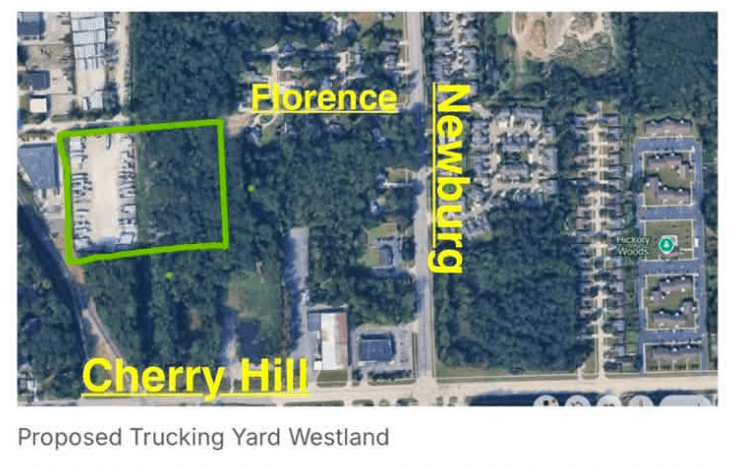
A Wayne County judge has overturned Westland City Council's unanimous rejection of a roughly 170-space truck parking expansion near a residential neighborhood. Now the City is preparing to appeal, and some important questions remain unanswered about how the project got this far and exactly what the court's ruling means.
A fight over a proposed truck parking expansion on Florence Street isn't over.
It may simply be headed to another courtroom.
According to information presented at Monday night's Westland City Council meeting, a Wayne County Circuit Court judge ruled from the bench on Aug. 6 in favor of the developer seeking approval for a large truck parking expansion near Florence Street.
The ruling reversed Westland City Council's denial of the project.
And this wasn't a close decision at City Hall.
The Westland Planning Commission recommended denial by a 6-1 vote.
The proposal then went before City Council, where all seven council members voted against it.
The developer appealed.
The judge disagreed with the City.
According to Westland City Attorney James Grisco, the judge's written order had not yet been signed and entered as of Monday night's meeting.
"The case isn't formally closed yet," Grisco explained, according to reporting from the meeting.
Once that written order is entered, Westland will have decisions to make about what happens next.
One of those decisions now appears to be whether and how the City continues the fight through an appeal.
How Does a 7-0 Decision Get Overturned?
That's one of the first questions Voice of Westland wants answered.
It's easy to look at a unanimous City Council vote and assume the City must have had an unbeatable case.
That's not how this works.
Grisco explained that because the dispute involved a special land use decision, the court proceeding was largely based on the record already created during the Planning Commission and City Council proceedings. This wasn't simply a new trial where everyone started over and presented an entirely new case.
That makes the record incredibly important.
What evidence was actually before the court?
Were Council's reasons for denying the project clearly documented?
Did the City sufficiently explain how the proposal failed to satisfy the standards required for approval?
Was important information missing from the record?
And most importantly, what specifically did the judge believe Westland got wrong?
Until we see the final written order and understand the court's reasoning, we're not going to pretend we know the answer.
Why Is Westland Appealing?
Councilwoman Melissa Sampey attempted during Monday night's meeting to add an item to the agenda that would have directed the City to continue fighting the decision.
Since then, Mayor Kevin Coleman has indicated the City intends to pursue an appeal.
That creates another set of questions.
What legal or factual error does Westland believe the judge made?
Does the City believe the court misinterpreted Westland's zoning ordinance?
Does the City believe the judge gave insufficient consideration to the reasons Council denied the special land use?
Or is there something bigger at stake?
If this decision stands, could it affect Westland's ability to make and defend future land-use decisions?
Those are questions the Mayor and City Attorney should be able to address without revealing confidential litigation strategy.
How Did Westland Defend Its Decision?
There's another uncomfortable but necessary question.
Is the City satisfied with how this case was defended?
A Planning Commission recommendation of 6-1 followed by a 7-0 City Council denial sounds decisive politically.
But courts don't count votes and stop there.
The strength of the City's position depends on the ordinance, the evidence, the findings, the administrative record and the applicable law.
So Voice of Westland wants to know whether City officials have reviewed how the case was handled.
Were the City's strongest arguments presented?
Was Council's reasoning adequately documented?
Was anything important missing?
Will the attorney handling the next appeal independently review the entire record?
And will Westland consider bringing in attorneys with specific appellate or Michigan land-use experience if that's necessary?
Those aren't accusations.
They're questions that should be asked anytime a court overturns a unanimous decision of the City's elected council.
What About the Other Properties?
Another part of the case deserves closer examination.
The developer reportedly cited other Westland properties as examples of comparable uses.
But businesses aren't necessarily comparable simply because trucks or trailers can be found on the property.
What are those properties actually approved to do?
Are diesel-powered semi tractors stored and operated there?
Are they primarily storing unpowered trailers or RVs?
Are trucks staged or dispatched from those locations?
What are their hours of operation?
How close are those operations to residential homes?
Voice of Westland wants to know whether the City independently examined those properties and determined whether they truly operate like the Florence Street proposal.
If comparisons helped form part of the argument against Westland, residents deserve to know whether they were apples-to-apples comparisons.
And Then There's 38005 Florence
The lawsuit concerns the proposed expansion, but there is another issue that has been hanging over this controversy for more than a year.
The existing truck operation at 38005 Florence Street.
Residents living near the property say they have accumulated photographs, videos and observations documenting truck activity, idling, dust, noise, vibration and other conditions.
That raises a separate question from the lawsuit:
What exactly is 38005 Florence legally approved to do?
And then comes the obvious follow-up:
Does what's happening there today match that approval?
The City has previously directed residents to use the Freedom of Information Act to obtain records concerning the property's history.
Those records may help establish what was approved and how that approval may have changed over time.
But eventually someone still needs to answer the underlying zoning question.
The court's decision concerning the proposed expansion does not automatically answer what the existing property was approved to do or whether its present operation conforms to those approvals.
Those are separate questions, and Voice of Westland intends to continue asking them.
What About the Residentially Zoned Property?
There's another piece of this development that deserves much closer scrutiny.
Part of the property included in the plans is residentially zoned.
According to the plans and information surrounding the proposal, that residential portion would be used for stormwater retention, detention or bio-retention associated with the development.
That raises what seems like a pretty straightforward question:
Can residentially zoned property in Westland legally be used as a stormwater retention or detention facility whose purpose is to serve an industrial development on neighboring property?
Voice of Westland is not saying the answer is no.
We're asking the City to explain why the answer is yes.
If Westland's zoning ordinance permits this arrangement, what specific provision allows it?
How is that portion of the property classified for zoning purposes?
Is the retention area considered an accessory use?
A utility?
Landscaping?
Stormwater infrastructure?
Something else entirely?
And if the City considers the retention area an accessory use, another question follows:
What principal use on the residentially zoned property is that retention facility accessory to?
There's also a practical question that could tell us quite a bit:
Could the proposed industrial development satisfy its stormwater requirements without using the residentially zoned portion of the property?
If it could, that's one thing.
If it couldn't, then the residentially zoned property may be performing a function necessary for the industrial development to operate as proposed.
That distinction deserves an explanation.
Voice of Westland intends to ask the City's Planning Department, City Attorney and the developer or the developer's representatives the same basic question:
What provision of Westland's zoning ordinance permits this arrangement?
If there is a clear answer, we'll report it.
If there isn't, we'll report that too.
Could the Developer Begin Work While Westland Appeals?
Another question is becoming increasingly important.
What happens while an appeal is underway?
An appeal doesn't necessarily mean everything automatically stops.
Once the Circuit Court's final written order is entered, can the developer begin moving forward?
Will Westland seek to prevent work from beginning while the appeal is pending?
If the developer can proceed, what additional permits, engineering approvals, site-plan requirements or other conditions must still be satisfied?
And what happens if construction begins and Westland later wins the appeal?
Residents living next to the proposed development deserve to understand what happens on the ground while lawyers continue fighting in court.
What Happens If There's a Settlement?
Appeals don't always end with another judge issuing another ruling.
Sometimes the parties settle.
If that happens here, the public should understand the process.
Who has authority to approve a settlement?
If a settlement materially changes what City Council originally denied, does it have to come back before Council?
Would Council have to vote publicly?
Would residents receive notice before that vote?
There are legitimate reasons attorneys cannot discuss confidential litigation strategy.
Nobody should expect the City Attorney to reveal privileged conversations.
But residents can still ask what public process would be required before the City formally agrees to something different from what Council previously decided.
There's a Bigger Question Here
Regardless of who ultimately wins this lawsuit, Westland may need to look beyond this particular property.
Are the City's zoning rules clear enough when intensive truck operations are proposed next to residential neighborhoods?
Should Westland have specific standards addressing truck terminals, large truck parking facilities and heavy vehicle storage near homes?
Should the ordinance more clearly address buffers, noise, dust, lighting, vibration, diesel idling and the use of residentially zoned property to support neighboring industrial developments?
Those questions don't have to wait for a judge.
When we get answers, we'll report them.
Transparency note: Voice of Westland has a direct connection to residents who participated in the Florence Street land-use proceedings. Because of that connection, our coverage will clearly distinguish documented facts from allegations and opinion, seek responses from the City and the developer, and disclose relevant conflicts when appropriate.
Brian R. Hopkins
Editor-in-Chief, Voice of Westland