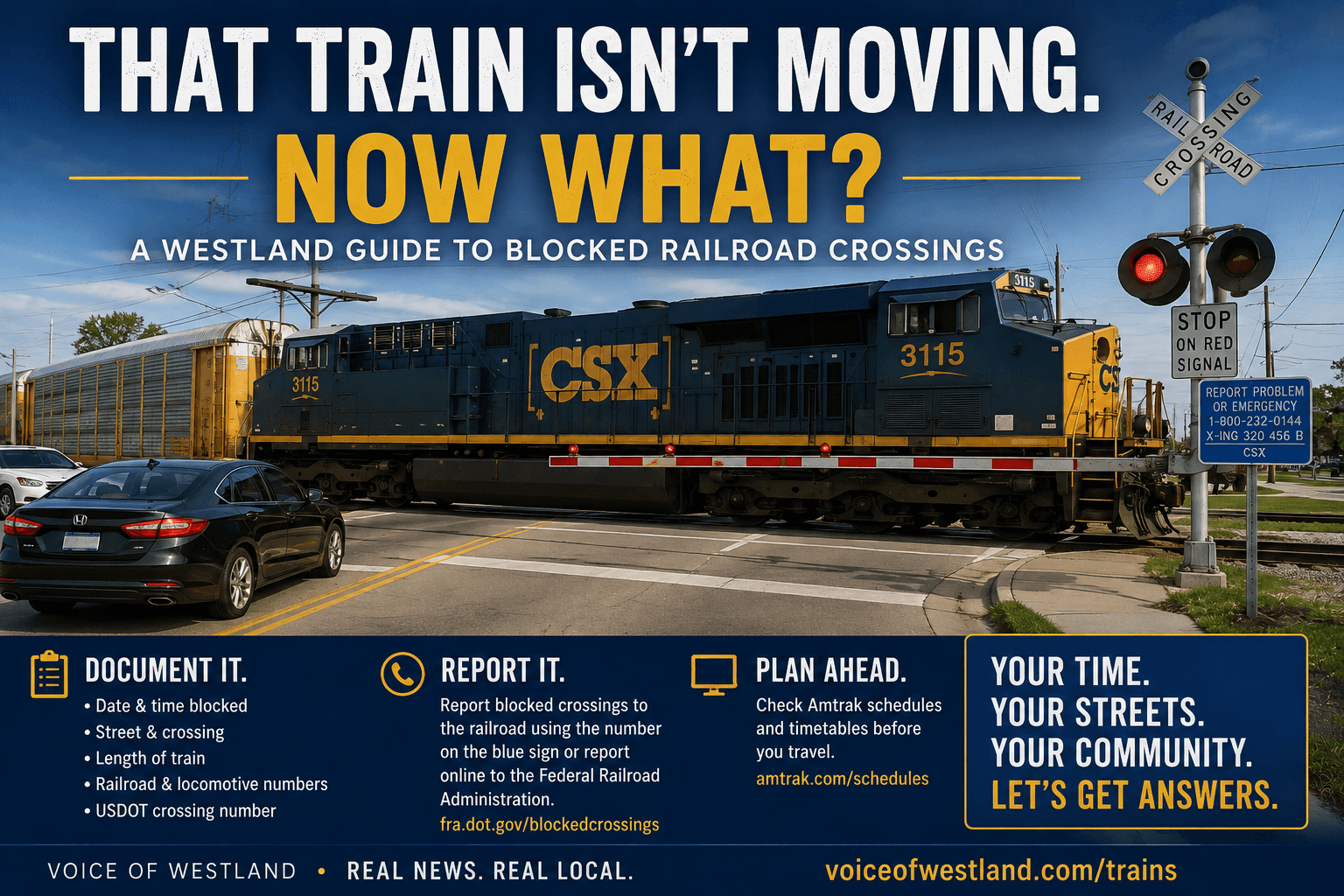
That Train Isn't Moving. Now What? A Westland Guide to Blocked Railroad Crossings
Westland residents have dealt with trains stopping across roads for years. Here's how to report a blocked crossing-and how to know where passenger trains are headed.
WESTLAND, MI -You know the feeling.
You're on your way to work. You're trying to get the kids somewhere. You're running late for an appointment.
Then you see it.
A train.
And it's not moving.
You wait.
And wait.
And wait some more.
For many Westland residents, a train stopped across a roadway isn't an unusual occurrence. It is a frustration that has been part of getting around the city for years.
But here's something many people may not realize:
You don't have to simply sit there and complain about it. You can report it.
Voice of Westland has created a dedicated Trains page to make it easier for residents to find the information they need when a train blocks a Westland crossing.
Visit the Voice of Westland Trains page
First: Don't assume someone else reported it
The Federal Railroad Administration has a public Blocked Crossing Incident Reporter specifically for situations where a train is blocking a highway-rail crossing.
The FRA says the information is collected to help identify where crossings are being blocked, when they're being blocked, how long they're blocked and what impacts they are having on the community.
That matters.
If Westland residents repeatedly encounter the same problem at the same crossing, a record of those incidents can help demonstrate that the problem isn't simply one person's bad day.
It's a pattern.
What should you record?
If you're safely stopped at a crossing and a train isn't moving, take a moment to document what you're seeing.
Write down:
The date
The time the crossing became blocked
The time the crossing reopens
The street you're on
The approximate length of the train
The railroad, if identifiable
The locomotive numbers, if you can safely see them
The USDOT crossing number
That last number is particularly useful.
Look for the blue emergency information sign near the crossing. The sign contains information identifying the crossing, including its USDOT number.
Michigan's Department of Transportation specifically advises residents reporting railroad problems to provide that number.
Don't walk onto the tracks to get information.
Your safety comes first. Never climb over, under or between railroad cars, and never approach a moving train to obtain a number or photograph.
Who do you report it to?
There are several different kinds of railroad problems, and knowing where to send the complaint can make a difference.
Emergency? Call 911 and the railroad.
If there's an immediate danger involving the crossing such as a vehicle stuck on the tracks, a damaged crossing or another emergency Michigan officials advise contacting local law enforcement and the railroad's emergency number shown on the blue sign at the crossing.
Train blocking the crossing?
Michigan's MDOT says blocked crossings should be reported to the railroad using the telephone number on the blue emergency sign.
MDOT also directs residents to the federal government's online blocked-crossing reporting system.
Report a blocked crossing to the Federal Railroad Administration
Crossing equipment isn't working?
If the gates, lights or warning devices aren't functioning properly, MDOT says to contact the railroad using the number on the blue emergency sign.
For problems involving the crossing surface or sight distance, MDOT's Rail Safety Section is the appropriate contact.
And yes, there is a reason trains sometimes sit
It's easy to assume that a railroad is simply ignoring traffic when a train sits across a road.
Sometimes there are operational reasons.
A train may be waiting for another train, entering or leaving a yard, dealing with mechanical problems or dealing with crew-related issues.
The important point is that reporting a blocked crossing doesn't necessarily mean the railroad has violated a law.
In fact, the FRA explicitly says there are currently no federal laws or regulations governing how long a train may block a crossing, and its reporting system is primarily designed to gather information about the problem.
That's an important distinction.
You're not necessarily reporting a crime.
You're creating a record.
What about Amtrak?
Here's another useful piece of information for Westland residents:
Not every train you see around Westland is an Amtrak train.
Freight railroads and passenger railroads operate differently, and an Amtrak schedule cannot be used to predict when a freight train will arrive at a particular Westland crossing.
But if you're interested in passenger rail, Amtrak provides an official schedule tool where you can enter your origin, destination and travel dates to see current schedules.
Check Amtrak schedules and timetables
Amtrak's current schedule system allows travelers to create a customized timetable and see departure and arrival information for available trips.
Why Voice of Westland created the train page
Because this is exactly the kind of information a local newspaper should make easy to find.
You shouldn't have to search Google for 20 minutes while you're sitting behind a stopped train trying to figure out:
Who do I call?
Where do I report it?
What information do I need?
Is there a record of other incidents?
That's why the VOW Trains page puts the important resources together in one place.
And here's where residents can help
If you've been stuck behind a train in Westland, don't just remember it. Document it.
If it happens again, write down the time.
If you can safely do so, note the crossing.
Find the USDOT number.
Report the incident.
And if you see the same crossing repeatedly blocked, tell Voice of Westland.
That information can become part of a bigger story.
Because one resident saying, "That train was there forever" is a complaint.
But 50 residents documenting the same crossing, the same problem and the same delays over months?
That's data.
And data gives a community something much more powerful than frustration.
It gives residents a reason to start asking questions.
How often are Westland crossings blocked?
Which crossings are affected most often?
How long are they blocked?
Are emergency responders being delayed?
And what, if anything, can be done about it?
Those are questions worth answering.
So the next time a train stops you in Westland, don't just honk your horn and stare at it.
Document it. Report it. And tell us about it.